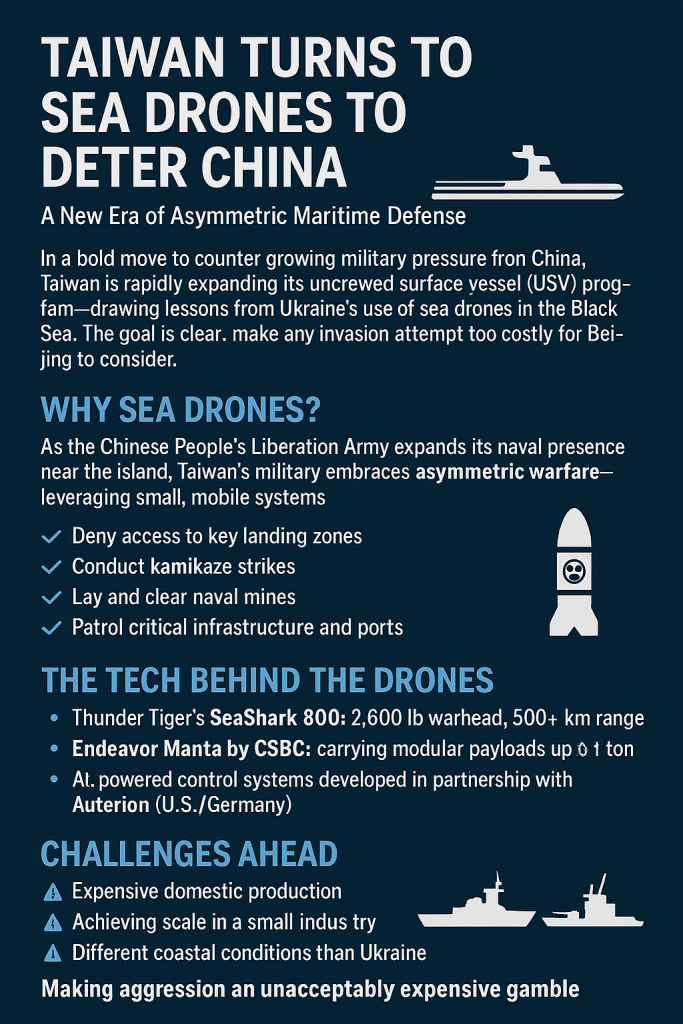
In a bold move to counter growing military pressure from China, Taiwan is rapidly expanding its uncrewed surface vessel (USV) program—drawing lessons from Ukraine’s use of sea drones in the Black Sea. The goal is clear: make any invasion attempt too costly for Beijing to consider.
Why Sea Drones?
As the Chinese People’s Liberation Army (PLA) expands its naval presence in the Taiwan Strait, Taiwan’s military is embracing asymmetric warfare—leveraging small, mobile, cost-effective systems to offset a numerically superior enemy. Sea drones, capable of reconnaissance, mine-clearing, suicide strikes, and harbor defense, fit neatly into this doctrine.
Inspired by Ukraine’s Magura V5 drones that wreaked havoc on the Russian Black Sea Fleet, Taiwan is racing to operationalize its own fleet of advanced sea drones.
The Tech Behind the Drones
At a recent defense showcase in the port town of Suao, multiple Taiwanese and international manufacturers displayed combat-ready prototypes:
- Thunder Tiger’s SeaShark 800: Equipped with a 2,600-pound warhead and a range of over 500 km, this high-speed strike drone is built for offensive missions.
- CSBC’s Endeavor Manta: A trimaran-style vessel capable of carrying 1-ton payloads, including modular torpedoes and surveillance equipment.
- AI-powered Control Systems: Taiwan has signed agreements with Auterion (U.S./Germany) to integrate advanced autonomous swarming software already tested in combat conditions in Ukraine.
This technological push aligns with Taiwan’s wider goal to build over 3,200 drones by 2028, covering land, sea, and air domains.
Strategic Utility
Unlike conventional vessels, sea drones are cheap, expendable, and hard to detect. Deployed in swarms, they can:
- Deny access to key amphibious landing zones
- Conduct kamikaze strikes against Chinese landing craft
- Lay and clear naval mines
- Patrol critical infrastructure and ports
Analysts believe these systems could help neutralize China’s quantitative advantages, transforming the Taiwan Strait into a maritime “hellscape”—a term U.S. advisors use to describe a battlefield saturated with autonomous weapon systems.
Challenges Ahead
Despite the promise, Taiwan faces significant obstacles:
- High Costs: Domestic production is expensive due to a policy of sourcing non-Chinese components.
- Scale Limitations: Taiwan’s defense industry is relatively small, raising questions about whether it can produce drones at the needed scale.
- Environmental Factors: Taiwan’s coastal conditions differ from Ukraine’s; effectiveness in the rougher Taiwan Strait remains unproven.
- Operational Integration: Seamlessly integrating drones into Taiwan’s naval doctrine, training, and communication systems is a nontrivial challenge.
U.S. Involvement
Taiwan’s drone development has drawn strong support from the U.S. Former Google CEO Eric Schmidt and other defense influencers are advocating for sea drones as a deterrent backbone. Washington has provided tech partnerships, training, and strategic advice as part of its Indo-Pacific deterrence strategy.
A Maritime Future Shaped by AI and Autonomy
As tensions continue to rise across the Taiwan Strait, Taiwan’s sea drone program represents a paradigm shift in maritime defense—from massive destroyers to intelligent swarms. If successful, it could offer a blueprint for other small nations facing large adversaries in contested waters.
For Taiwan, it’s not about matching China ship-for-ship. It’s about rewriting the rules of naval warfare—making aggression an unacceptably expensive gamble.
대만, 중국 견제를 위한 해상 드론 전략…‘비대칭 해양 방어’의 전환점
대만이 무인수상정(USV)을 활용한 해상 드론 전략으로 중국의 위협에 맞서고 있다. 우크라이나의 흑해 전투 경험을 본보기로 삼은 이 접근은, 전통적인 함정 위주의 방어 전략을 넘어서는 새로운 국방 패러다임을 보여준다.
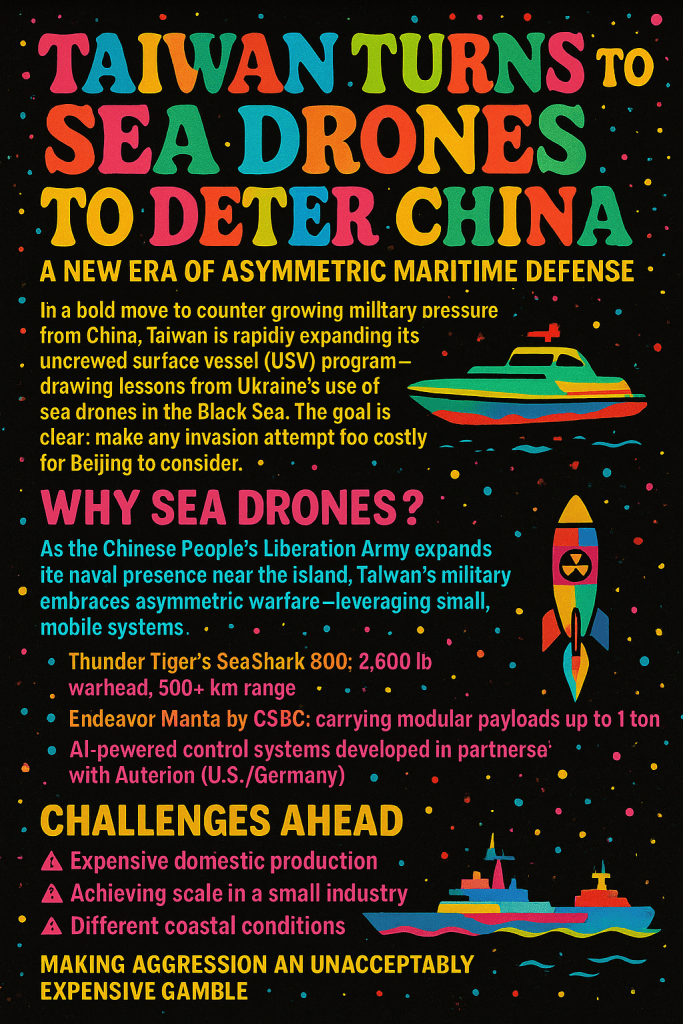
최근 대만은 중국 인민해방군 해군의 활동이 대만 해협과 동중국해 일대에서 심화됨에 따라, 값비싸고 대형화된 구축함 대신 소형·기동성·저비용의 무인 해상 드론 전력을 강화하고 있다. 이러한 전략은 중국의 침공을 ‘지나치게 비싼 선택’으로 만들겠다는 목표 하에 추진되고 있다.
왜 해상 드론인가?
대만군은 중국의 대규모 해군력에 대응하기 위해 ‘비대칭 전력(asymmetric warfare)’을 강화하고 있다. 이는 거대 해군력과 정면충돌을 피하고, 보다 창의적이고 유연한 방식으로 억제력을 확보하는 개념이다.
해상 드론은 이러한 전략에 가장 적합한 도구 중 하나다. 특히 다음과 같은 목적에 활용된다:
- 상륙 예상 지점 봉쇄
- 자폭 공격 및 돌격 임무
- 기뢰 부설 및 제거
- 주요 항만 및 해양시설 정찰
특히 자폭형 드론은 고속으로 접근해 상대 함정에 치명적인 타격을 입힐 수 있어, 중국의 상륙 작전을 효과적으로 저지할 수 있다.
주요 기술과 전력
최근 대만의 수오(蘇澳)항에서 열린 전시회에서는 국내외 10여 개 기업이 해상 드론을 선보였다. 대표적인 모델은 다음과 같다:
- 🔹 Thunder Tiger사의 SeaShark 800: 2,600파운드 탄두 탑재, 500km 이상 작전거리
- 🔹 CSBC의 Endeavor Manta: 3선체(트라이마란) 디자인, 최대 1톤 모듈형 탑재물 운용 가능
- 🔹 Auterion(미국/독일)과의 제휴: 우크라이나 전장에서 검증된 AI 기반 자율 조종 시스템 탑재
이 외에도 대만은 향후 5년간 3,200기 이상의 드론(해상·지상·공중 포함)을 양산할 계획이며, 미측과의 협력을 통해 훈련 및 기술 이전도 진행 중이다.
그러나 넘어야 할 과제들
대만의 해상 드론 전략은 분명히 혁신적이지만, 몇 가지 도전과제도 존재한다.
- 💰 높은 생산비용: 중국산 부품을 배제한 탓에 자체 제작 비용이 상승
- 🏭 산업기반 부족: 방산업체 규모가 작아 대량생산에 한계
- 🌊 작전 환경 차이: 흑해와는 다른 대만 해협의 파도, 조류, 수심 등에서의 작전 검증 부족
또한, 기존 해군전력과의 지휘·통제 시스템 통합, 정비 및 운용 유지 체계 구축도 필수적이다.
미국의 지원과 전략적 함의
에릭 슈미트 전 구글 CEO 등 미국 전략가들은 대만의 해상 드론 전략을 ‘지옥의 전장(Hellscape)’ 구상이라 부르며 지지하고 있다. 이는 침공 시도 시 드론이 해·공·육 전장에서 집단 공격을 수행해 침공 비용을 극대화하는 개념이다.
이처럼 대만은 단순히 방어를 위한 무기 배치가 아닌, 전쟁의 규칙 자체를 바꾸는 시도를 하고 있다.
마레의 시선 (Mare’s View)
해양안보 전문가의 입장에서 볼 때, 대만의 이 전략은 단순한 전력 보완을 넘어 해양 분쟁 시대의 새로운 패러다임을 제시하고 있다. 특히 중소 해양국가들에겐 ‘드론 기반의 억제 전략’이라는 실현 가능한 대안을 제공한다.
대한민국 역시 비슷한 위협 속에 놓여 있는 만큼, 향후 해양경찰, 해군, 방산업계 모두가 드론 전력의 전술적·전략적 활용에 대한 연구와 투자가 필요하다.


Leave a Reply