🌊 Introducing UNCLOS: The Constitution of the Oceans
When we think about the vast oceans covering over 70% of our planet, it’s easy to forget that they are not lawless frontiers. Instead, they are governed by one of the most important international legal instruments of our time: UNCLOS, the United Nations Convention on the Law of the Sea.
📜 What is UNCLOS?
UNCLOS, often called the “constitution of the oceans,” is an international treaty that sets out the legal framework for all activities in the world’s seas and oceans. Adopted in 1982 and entering into force in 1994, UNCLOS governs everything from navigation rights, maritime boundaries, and exclusive economic zones (EEZs) to deep-sea mining, environmental protection, and marine scientific research.
Today, over 160 countries and the European Union are parties to UNCLOS, making it one of the most widely accepted treaties in international law.
🌍 Why is UNCLOS Important?
UNCLOS balances freedom of the seas with sovereign rights of coastal States. It establishes:
- Territorial seas (up to 12 nautical miles),
- Contiguous zones (up to 24 nautical miles),
- Exclusive Economic Zones (up to 200 nautical miles), and
- Continental shelf rights.
It also provides mechanisms for dispute resolution, ensuring peaceful cooperation between nations.
⚖️ Key Principles
Some of the cornerstone principles include:
- Freedom of navigation and overflight,
- Protection and preservation of the marine environment,
- Equitable use of marine resources,
- Marine scientific research under international rules.
UNCLOS also introduced landmark concepts like the Common Heritage of Mankind for deep-seabed resources.
🚢 UNCLOS and Maritime Security
For maritime law enforcement agencies like coast guards and navies, UNCLOS offers the legal basis to act against:
- Piracy,
- Drug smuggling,
- Human trafficking,
- Illegal fishing.
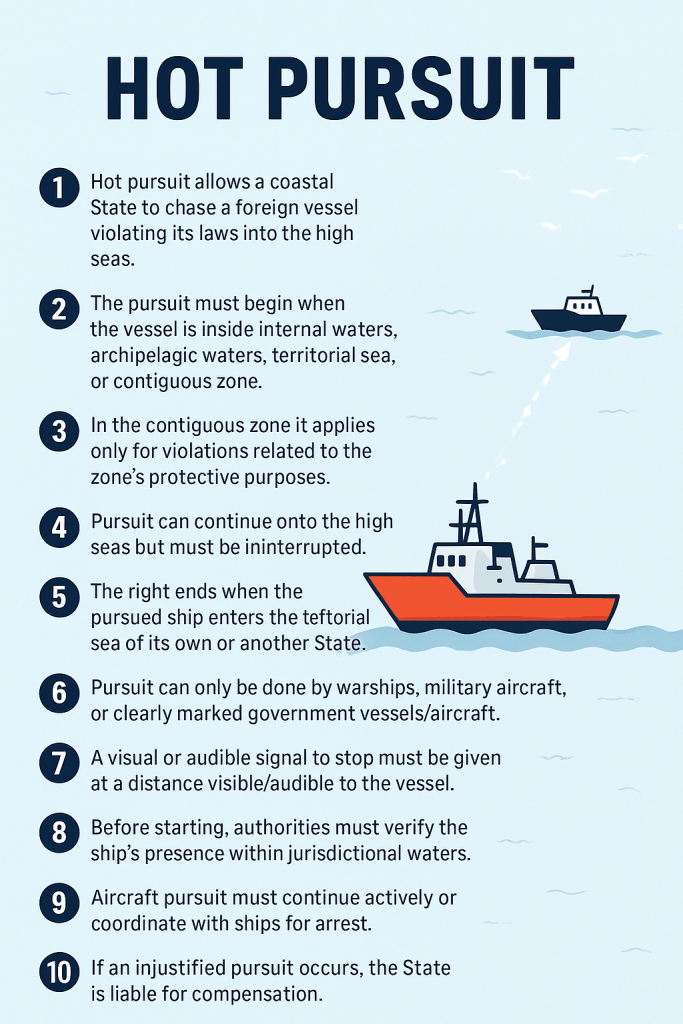
Notably, Article 111 outlines the right of hot pursuit, allowing coastal States to chase law-breaking vessels beyond their territorial sea.
🌐 UNCLOS in Today’s World
In an era of climate change, rising sea levels, and geopolitical tensions in maritime zones, UNCLOS remains essential. It is the backbone of international efforts to manage ocean resources fairly, protect marine biodiversity, and ensure that no country unilaterally dominates the seas.
💬 At MarePress, we believe that understanding UNCLOS is not just for lawyers or diplomats — it’s for anyone passionate about the oceans and their future. Stay tuned for more posts unpacking its articles, challenges, and real-world applications!
If you’d like, I can draft follow-up articles on specific UNCLOS topics (like deep-sea mining, maritime boundaries, or dispute cases). Just let me know! 🌊✍️
Columns
Hot Pursuit
 You are now at Maritime Security Insights