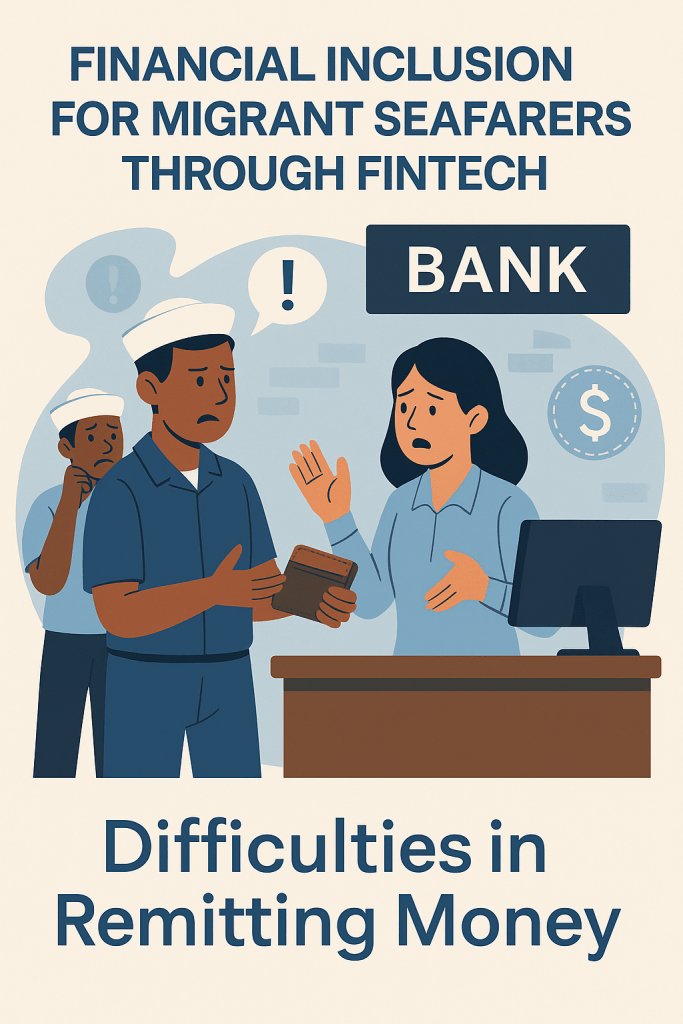
Abstract
This paper reviews theoretical and literature-based evidence on fintech applications (digital wallets, mobile banking, blockchain remittances, microinsurance) to enhance financial inclusion for Indonesian and Vietnamese migrant seafarers, especially those working in South Korea. We situate this analysis within Official Development Assistance (ODA) and international development cooperation frameworks. Fintech solutions can significantly lower remittance costs and improve access: e.g. mobile money transfers average ~4.1% fees versus ~12% through banksmigrationpolicy.org. Blockchain-based platforms also enhance transaction transparency and securityoecd.org. Korea’s policies (such as permitting non-bank remittance providers) and ODA partnerships create enabling conditions. For example, Bank Rakyat Indonesia’s agreement with Korean fintech E9pay is expanding digital remittances for tens of thousands of Indonesian migrants in Koreaibsintelligence.comibsintelligence.com. Korean ODA-funded fisheries training and data-sharing programs (Indonesia–Korea) likewise build capacity and protection for seafarersen.antaranews.comen.antaranews.com. We identify policy and partnership opportunities: integrating fintech into ODA and public–private initiatives (e.g. digital wallets, microinsurance, and digital ID) can strengthen social protection, enhance transparency, and make remittances more efficient. ASEAN–Korea collaboration (ODA grants, PPPs) is recommended to scale fintech-enabled services and meet SDG financial inclusion goals.
Keywords
- Fintech
- Financial inclusion
- Migrant seafarers
- Remittances
- Official Development Assistance (ODA)
- Korea–ASEAN cooperation
Introduction
Migrant workers play a vital economic role by sending remittances that support families and economies of origin. In 2023, remittances to Indonesia and Vietnam amounted to roughly USD 14–15 billion eachdocuments1.worldbank.orgdocuments1.worldbank.org. Many of these flows originate from workers abroad, including seafarers from Indonesia and Vietnam employed in foreign fleets. Indeed, South Korea’s merchant fleet in 2020 included 10,669 Indonesian and 5,025 Vietnamese seafarersmdpi.com, comprising nearly 60% of its foreign maritime workforce. These “national heroes” rely heavily on remittances for their families’ livelihoods, but often face high transfer costs, limited banking access, and exposure to informal financial risks. Traditional remittance channels can cost migrants around 6–7% of the transfer amountasiamattersforamerica.org, far above the 3% SDG targetasiamattersforamerica.orgmigrationnetwork.un.org.
Fintech—encompassing digital wallets, mobile banking, blockchain, and insurtech—offers tools to reduce these frictions. Smartphone penetration is rising in Indonesia and Vietnam, and new non-bank providers are expanding financial inclusion in those marketswomensworldbanking.orgdocuments1.worldbank.org. For example, Indonesia saw a 2.5× increase in e-money usage from 2018–2020womensworldbanking.org. However, barriers remain: migrants often lack formal IDs, have limited digital literacy, or face regulatory hurdles abroad. South Korea’s New Southern Policy (NSP) emphasizes a “people-centered” community with ASEAN, including digital economy cooperationkiep.go.kroecd.org. Korea’s ODA agencies (e.g. KOICA) are integrating digital components across development projectsoecd.orgoecd.org.
This paper reviews how fintech innovations can be leveraged—through ODA projects, PPPs, and bilateral cooperation—to serve Indonesian and Vietnamese seafarers. We draw on recent studies (2022–2025) and policy reports. Section 2 reviews global and regional literature on fintech for migrant inclusion. Section 3 analyzes specific fintech solutions (digital wallets, blockchain remittances, microinsurance) and partnerships (e.g. BRI–E9pay, EzyRemit–Vietcombank) that target this population. Section 4 considers the role of Korea–ASEAN cooperation, including ODA programs and bilateral agreements (e.g. QR-code payment integrationfinancemagnates.com). Section 5 discusses sustainable development implications (SDG 8 & 10) and policy lessons. A conclusion summarizes findings and recommendations.
Literature Review
Migrant Remittances and Financial Inclusion
Remittances often represent migrants’ first and most important link to formal finance. Globally, remittance flows to low- and middle-income countries reached USD 656 billion in 2023documents1.worldbank.org, exceeding both foreign direct investment and ODAdocuments1.worldbank.org. In ASEAN, remittances contribute substantially to GDP and poverty reductiondocuments1.worldbank.org. World Bank forecasts indicate remittances to Vietnam and Indonesia will continue to grow, reaching ~$15 billion by 2025documents1.worldbank.org. Yet high fees erode these benefits. For example, migrant workers in Korea face transfer fees averaging 6.86% to Southeast Asiaasiamattersforamerica.org, much higher than the SDG target of 3% under SDG 10.casiamattersforamerica.orgmigrationnetwork.un.org.
Financial inclusion aims to bring underserved populations into formal finance, offering savings, payments, credit, and insurance. Recent literature emphasizes fintech’s role in achieving this goal. Digital payments, mobile banking, and crypto solutions are increasingly studied as vehicles to lower remittance costs and expand servicesey.commigrationpolicy.org. A Migration Policy Institute report (“Leaving No One Behind”) highlights fintech remittances as critical for migrants, noting that linking remittances to other financial products (like insurance and credit) can improve migrants’ financial resiliencemigrationpolicy.orgmigrationpolicy.org. Similarly, UNCDF’s Migrant Money program examines remittance corridors and the adoption of digital remittances apps (e.g. Sentbe) in East Asia, finding that apps can reduce costs and improve access for migrantsmigrantmoney.uncdf.orgasiamattersforamerica.org.
Challenges remain: KYC requirements and lack of ID can exclude migrants from digital financemigrationpolicy.org. The digital gender gap also persists; for instance, in Indonesia many female migrants (a majority of migrants) lack smartphoneswomensworldbanking.orgwomensworldbanking.org. Nonetheless, the literature suggests significant potential: fintech products tailored to migrants, supported by partnerships, can overcome barriers and extend formal services to marginalized workers.
Fintech in ASEAN and Myanmar
ASEAN countries have progressively built regulatory frameworks for digital finance. For example, Indonesia permits licensed non-bank e-money issuers and cross-border fintech payment channelsdocuments1.worldbank.org. Vietnam’s central bank has promoted digital payment and inclusion initiatives, aiming for 80% adult account ownership by 2025vir.com.vn. FinTech growth in Vietnam is strong, with startups like VNPay, MoMo, and Payoo expanding digital wallets and paymentsey.com. However, Vietnam still lags some neighbors: reports note that fintech adoption and financial inclusion indices remain uneven in Vietnamey.compreprints.org. For migrants specifically, data are scarcer. One study of women’s digital remittances in Southeast Asia found that understanding local context (e.g. token flight) is essentialmigrationpolicy.org.
In Indonesia, e-money regulation (Payment System regulations 2014–2018) has fostered rapid e-wallet growth. The Financial Inclusion Insight Survey (2020) showed a 19.5% rise in awareness of e-money since 2018womensworldbanking.org. Mobile network operators and banks have launched wallet services (GoPay, OVO, DANA) that reach millions. Yet these services often focus on domestic transactions; linking them with international remittances requires partnerships. An emerging approach is diaspora-targeted fintech: e.g. Australian startup EzyRemit (serving Vietnamese diaspora) signed an MoU with Vietnam’s Vietcombank Remittance to facilitate low-cost transfersaustrade.gov.au.
Overall, literature underscores the promise of digital finance for migrants, but also notes risks: cybersecurity, digital literacy, and coordination among regulators. Bridging these gaps is a focus of recent ASEAN cooperation agendasdocuments1.worldbank.org.
Fintech Innovations for Migrant Seafarers
This section analyzes specific fintech solutions that can empower Indonesian and Vietnamese seafarers by enabling remittances, savings, and other financial services.
Digital Wallets and Mobile Banking
Mobile wallets have transformed domestic payments in Indonesia and Vietnam, and now are being extended to support migrants. In Indonesia, DANA is a leading e-wallet with millions of users. Women’s World Banking (2021) partnered with DANA to design remittance services targeting female migrant workerswomensworldbanking.org. Their work highlights how leveraging an e-wallet’s technology can provide low-cost, convenient remittances to rural households, fostering economic stability. Similarly, Bank Rakyat Indonesia (BRI), the world’s largest microfinance bank, has extended digital banking to migrants. BRI’s BRImo super-app offers savings, remittances, and foreign exchange. In Taiwan, BRI opened a branch serving 360,000 Indonesian workers, offering BRImo Taiwan – a localized app enabling seamless transactions and remittances to Indonesiaprnewswire.comprnewswire.com. BRI plans to deploy a similar app for Korean operations. These examples show how existing fintech ecosystems (DANA, BRImo) can be harnessed for migrant inclusion via targeted product design and language support.
On the Vietnam side, fintech wallets like MoMo or ViettelPay could in principle serve migrants, though explicit programs have been less documented. Vietnam’s main remittance channels still involve banks and Money Transfer Operators. However, Indonesia’s model suggests that Vietnamese banks (e.g. BIDV, Vietcombank) and e-wallets could collaborate to reach overseas workers. Indeed, Australian fintech EzyRemit successfully partnered with Vietcombank Remittance (a state-owned entity) in 2023 to enhance money transfers for Vietnamese customersaustrade.gov.au. Though targeted at students and diaspora globally, the approach could be extended to maritime workers.
Blockchain-based Remittances
Blockchain and cryptocurrency technologies promise lower-cost, instant remittances. In South Korea, major fintech initiatives have embraced blockchain. Ripple’s xCurrent network partnered with Korean startups (Sentbe, Hanpass) to create RippleNet corridorsasiamattersforamerica.org. For example, Ripple-backed Cross app was launched (2018) to send money from Korea to countries like Thailand and Sri Lanka; it reduced fees by ~90% and cut transfer time to secondsasiamattersforamerica.org. More recently, Ripple announced partnerships with Sentbe and Hanpass in 2020 to expand into other ASEAN corridors (e.g. Cambodia, Vietnam)asiamattersforamerica.orgasiamattersforamerica.org. These blockchain solutions focus on transparency and tracking, which can greatly benefit migrants.
In development practice, UNCDF and partners have piloted blockchain for financial inclusion. In Nepal, UNCDF worked with Laxmi Bank and blockchain firm New Street Technologies to create remittance-linked savings and credit products for migrantsmigrationpolicy.org. Though not in ASEAN, it demonstrates using distributed ledger tech to overcome information asymmetries, a model applicable to ASEAN corridors.
While crypto remittances face regulatory hurdles, the trend is accelerating. For Indonesian seafarers, a localized blockchain remittance service could be offered through Korean financial institutions or fintechs, possibly facilitated by ODA projects. For Vietnamese seafarers, similar platforms (e.g. digital money operators in Vietnam embracing remittance crypto) could be envisioned in collaboration with Vietnamese banks.
Microinsurance and Other Products
Financial inclusion is not just payments; it includes insurance and credit tailored to migrants. The Migration Policy Institute reports that remittance flows can be linked to microinsurance: for example, IFAD-funded NGO ADA (Luxembourg) and startup Democrance developed insurance products for Gulf migrants. Through partnerships with remittance providers (Hello Paisa, Rise) and insurer AXA, they offered life and asset insurance to Philippine and Indian migrants in the UAEmigrationpolicy.org. Over three years, 13,000 migrants (1/3 women) accessed policies via remittance channelsmigrationpolicy.org.
This model is relevant to Indonesian/Vietnamese seafarers. Many ASEAN migrants lack access to health or life insurance. Korean-ASEAN cooperation could support microinsurance programs: for instance, a Korean insurer could partner with an Indonesian digital wallet to offer shipboard insurance to seafarers, with premiums paid via mobile app. Likewise, Vietnamese insurers could link with fintech agents in Korea. Although specific Vietnam/Indonesia schemes are not documented in open sources, the ADA case suggests ODA funding (e.g. from ADB or KOICA) could seed such programs.
In Indonesia, the concept of kartu asuransi tenaga kerja migran (migrant worker insurance card) exists, often bureaucratic. Embedding microinsurance in fintech channels could greatly improve uptake among seafarers’ families.
Partnerships and Policy Innovations
Fintech adoption for migrants requires partnerships between banks, fintechs, governments, and development agencies. The BRI–E9pay MoU (May 2024) is a prime exampleibsintelligence.comsubsites.chinadaily.com.cn. BRI (Indonesia’s state-owned bank) is directly investing in Korean fintech E9pay to expand digital remittances. The agreement includes digital banking in Korea, streamlined account opening, and joint financial solutionsibsintelligence.com. Together, BRI and E9pay leverage E9pay’s app and BRI’s network (BRIfast Remittance), offering Indonesian migrants easy, Bahasa-based support and fast transfersibsintelligence.comsubsites.chinadaily.com.cn. This private-sector-led PPP exemplifies how diaspora-focused fintech can be scaled via bilateral ties.
Another partnership is E9pay–BP2MI: the Korean fintech and Indonesia’s migration agency signed an MoU to educate departing workers on digital remittancese9pay.co.kr. While details are limited, this reflects public-private cooperation to raise digital literacy among migrants.
At a multilateral level, Australia’s Austrade has facilitated connections for fintechs. The EzyRemit caseaustrade.gov.au shows how government trade agencies can catalyze fintech entry into ASEAN markets. Similar initiatives by Korean agencies (e.g. KOTRA or the Korea Eximbank) could support Indonesian/Vietnamese migrant fintechs.
Regulatory facilitation is also key. The Indonesia–Korea MoU on QR code payment systems (G20 roadmap)financemagnates.com, while aimed at tourism and trade, demonstrates high-level fintech cooperation. Integrating Indonesia’s QRIS with Korea’s system could indirectly benefit migrants by enabling low-cost digital payments in both countries. For instance, an Indonesian seafarer in Korea could use a Korean QR merchant network with their Indonesian e-wallet when visiting Indonesia.
Korea–ASEAN Cooperation in Practice
Official Development Assistance and Digital Strategy
Korea’s ODA has increasingly prioritized digital transformation. KOICA’s Digital Mainstreaming Strategy mandates that all projects include digital componentsoecd.org. KOICA also launched a Digital Transition Programme to enable partner countries’ e-government and digital infrastructure (e.g. e-ID systems, broadband)oecd.org. These strategies emphasize inclusivity: one guiding principle is an “inclusive approach for the marginalized”oecd.org. Financial inclusion initiatives for migrants fit this vision.
Korean ODA to Indonesia and Vietnam could explicitly include fintech components. For example, KOICA or EDCF funding might support a pilot digital remittance platform for seafarers, or mobile banking training. The Philippines’ experience (ADB-financed remittance projects) shows such programs can boost usage of formal channels. In Vietnam, Japan’s JICA has supported microfinance; Korea could similarly fund fintech-enabled microcredit for returnee workers.
Korea also cooperates with ASEAN institutions. The Korea-ADB partnership (KR-ADB Trust Fund) could channel grants for ASEAN digital finance. ASEAN itself has a Smart Cities Network and frameworks that include digital economy dialogues where remittances could be a theme. Korea’s 2019 ASEAN-ROK Commemorative Summit (Jakarta) and ongoing NSP dialogues cover SME and infrastructure cooperation, providing venues to raise migrant inclusion.
Bilateral and Multilateral Agreements
Bilateral agreements between Korea and Indonesia/Vietnam have begun to include digital finance. A notable example is the 2024 BI-BoK (Bank Indonesia – Bank of Korea) MoU on cross-border QR paymentsfinancemagnates.com. This pact, part of the G20 roadmap, aims to connect Indonesia’s QRIS with Korean payment systems, enabling direct settlements in local currenciesfinancemagnates.com. While intended for tourism and trade, it may lower remittance costs by reducing correspondent banking layers. Additionally, Korea is discussing similar arrangements with other ASEAN nations.
Korea’s New Southern Policy articulates three pillars (People, Peace, Prosperity)kiep.go.kr. Under “People,” Korea aims to improve migrants’ welfare (education, training). As a concrete step, Korea could expand programs on financial literacy for migrants, akin to traditional pre-departure trainings but with fintech. For instance, ODA-funded workshops might teach Indonesian seafarers in Jakarta how to use digital wallets before leaving, reducing their reliance on cash on arrival.
Korea also provides scholarships and vocational training in ASEAN. Embedding fintech modules (mobile money, remittances) into such programs would help prepare students and workers. Collaborative research (e.g. academic exchange on fintech inclusion) is another channel.
Public-private partnership (PPP) models are encouraged by both Korea and ASEAN. For example, Korea’s Ministry of Foreign Affairs and KOICA have co-hosted seminars on private sector ODA. Similar approaches could connect Korean fintech firms with ASEAN counterpart organizations.
Implications for SDGs and Development
Fintech-driven financial inclusion directly advances SDG 8 and SDG 10. By reducing remittance costs and formalizing transfers, migrants retain more earnings for consumption, savings or investment, contributing to decent living standards (SDG 8.10). Digital remittances mean faster, safer transfers, improving labor conditions for seafarers (SDG 8.8). Access to digital savings and credit helps migrant families invest in education or businesses, thus fostering economic growth and reducing poverty.
Regarding SDG 10 (Reduced Inequalities), inclusive fintech narrows the gap between migrant workers and formal-sector workers. Migrants often lack basic services; providing them with digital accounts and insurance levels the playing field. The UN’s Global Compact for Migration explicitly calls for financial access and remittance cost reduction, aligning with SDG 10.c. Fintech partnerships like BRI–E9pay exemplify this by making services “as accessible and stress-free…as in their home country”ibsintelligence.com.
Moreover, fintech inclusion has gender implications. In Indonesia, 70% of international migrants are womenwomensworldbanking.org. Many send remittances home and manage household finances. Targeted digital solutions (like the DANA partnership) empower these women by integrating them into the formal financial system.
Finally, public investment in digital infrastructure (aligned with KOICA’s Digital Accessibility pillaroecd.org) amplifies fintech benefits. For example, expanding mobile internet on remote Indonesian islands or Vietnamese rural areas makes it feasible for returned seafarers to use fintech for savings and remittances.
Conclusion
This review illustrates that a coordinated fintech strategy — involving digital wallets, mobile banking, blockchain, and insurance — can significantly enhance financial inclusion for Indonesian and Vietnamese migrant seafarers. Critical success factors include public–private collaboration and supportive policy. Recent initiatives, such as the BRI–E9pay MoUibsintelligence.comsubsites.chinadaily.com.cn and the QR code payment integrationfinancemagnates.com, demonstrate practical steps underway. Development cooperation can accelerate these by funding pilot projects, facilitating regulatory dialogue, and building digital infrastructure.
For South Korea and ASEAN (Indonesia, Vietnam), we recommend: (1) leveraging ODA to integrate fintech in migration programs (e.g. e-wallet remittance pilots, fintech training for migrants); (2) encouraging banks and fintechs to form PPPs (as with BRI-E9pay, EzyRemit-Vietcombank, TerraPay-MSBterrapay.com); (3) harmonizing regulations to allow cross-border digital finance (supporting bilateral MoUs and ASEAN initiatives); and (4) embedding financial inclusion metrics in ongoing Korea-ASEAN frameworks (e.g. NSP Plus). Through these measures, and with the involvement of diaspora financial institutions, the twin goals of decent work (SDG 8) and reduced inequality (SDG 10) can be better achieved for this vital but vulnerable worker population.
References
- Bank BRI & Korean FinTech E9pay to fuel financial inclusion in Indonesiaibsintelligence.com. IBSi FinTech Journal, May 14, 2024.
- Indonesian bank BRI invests in financial inclusion with South Korean fintech E9pay through MOUsubsites.chinadaily.com.cn. China Daily PR Newswire, May 8, 2024.
- Ferreira, P. (2024). Indonesia and South Korea Pave the Way for Seamless Digital Payments. FinanceMagnates (July 16, 2024)financemagnates.com.
- Kalosh, A. (2019). App for seafarers to securely send money home whilst at sea. Seatrade Cruise News (Apr 5, 2019)seatrade-cruise.com.
- TerraPay (2024). MSB and TerraPay Collaborate to Simplify and Enhance Cross-Border Money Transfers. (Press release, Sep 19, 2024)terrapay.com.
- Austrade (2024). Partnerships make for international transfer success in Southeast Asia and beyond. (Mar 12, 2024)austrade.gov.au.
- Women’s World Banking (2021). From Cash to Digital: Guiding Indonesia’s Migrant Workers to Use Digital Wallets. (Oct 25, 2021)womensworldbanking.orgwomensworldbanking.org.
- ADA Microfinance (2021) & UNCDF (2019). Linking Insurance with Remittances to Improve Resilience among Migrant-Sending Families (Fact sheet, April 2021); Blockchain for Financial Inclusion in Nepal (Apr 26, 2019)migrationpolicy.orgmigrationpolicy.org.
- OECD (2021). KOICA’s dual approach to digitalisation. OECD Development Co-Operation Directorate (Dec 17, 2021)oecd.orgoecd.org.
- Mei, A. (2020). San Francisco Fintech Expands into South Korea Remittances Market. AsiaMatters/Korea Matters (Apr 7, 2020)asiamattersforamerica.orgasiamattersforamerica.org.
- Lee, J. (2022). Equal Opportunities for Foreign Seafarers to Ensure Sustainable Development in the Korean Merchant Shipping Industry. J. Mar. Sci. Eng. 10(6):830 (MDPI)mdpi.com.
- Prnewswire (2025). BRI Launches Taipei Branch to Provide Financial Services for 360,000 Indonesian Migrant Workers in Taiwan. (Aug 14, 2025)prnewswire.comprnewswire.com.
- World Bank (2024). Migration and Development Brief 40: June 2024. (World Bank Group)documents1.worldbank.orgdocuments1.worldbank.org.
 You are now at Maritime Security Insights
Leave a comment