1. Introduction (Background & Necessity)
South Korea is a global shipbuilding powerhouse, ranking second in new ship orders (17% share) behind Chinacsis.org. In contrast, the U.S. shipbuilding base has eroded, facing aging fleets and chronic delays. The U.S. Navy’s fleet strength (about 295 ships in 2024) lags behind China’s (over 370)csis.orgcsis.org, and fleet readiness suffers from maintenance backlogs. Recently, amid trade tensions, Seoul proposed the “Make American Shipbuilding Great Again (MASGA)” initiative, offering up to $150 billion of Korean investment in U.S. maritime industriesthediplomat.com. MASGA’s goals include upgrading U.S. shipyards, training workers, addressing maintenance backlogs, and co-producing ships. This convergence of trade and security strategy highlights that Korean shipbuilding and MRO capabilities can bolster U.S. naval power. In August 2025, Korea’s Foreign Minister and U.S. officials visited HD Hyundai’s Ulsan shipyard to reaffirm that shipbuilding cooperation is a core pillar of the alliancemofa.go.kr. Against this backdrop, Korean MRO expertise — recently evidenced by contracts for U.S. Navy support ships — is seen as an urgent enabler for revitalizing American maritime strength.
2. MRO Concept and Position in Shipbuilding Industry
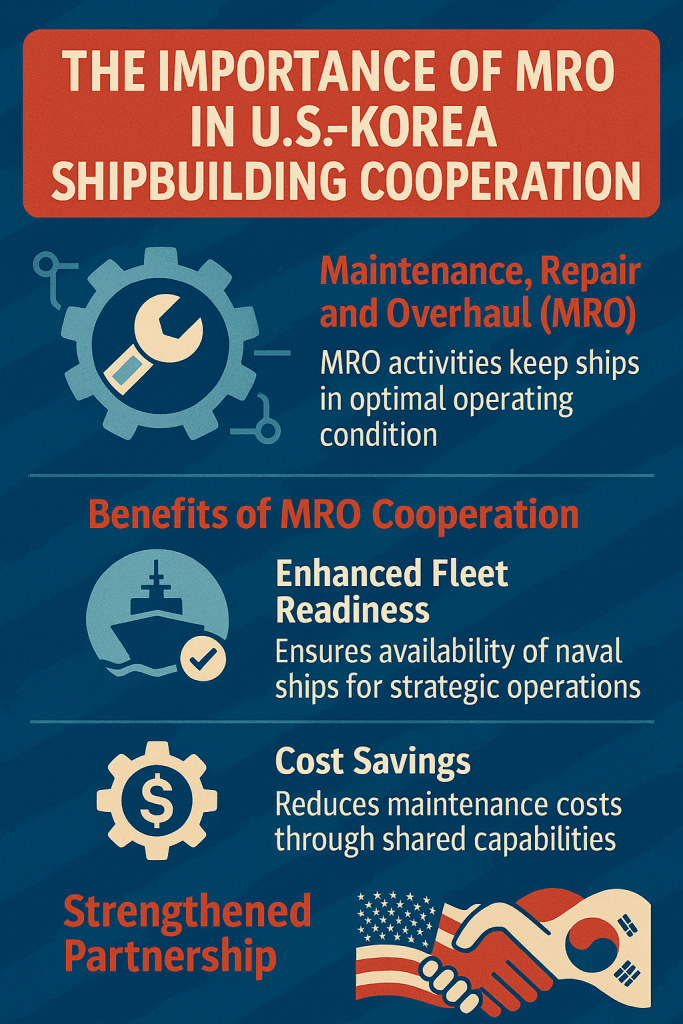
Maintenance, Repair, and Overhaul (MRO) refers to the periodic servicing of ships to ensure their operational readiness. MRO is inherently a long-term investment: defense analyses note that weapon system acquisition costs are only ~30% of life-cycle cost, while operations and support (maintenance) consume the remaining ~70%hanwha.com. Thus MRO is critical to sustaining capability and incorporating upgrades. The global naval MRO market is estimated at about $8 billion and growingnavalnews.com. Forward-deployed MRO (“forward sustainment”) shortens maintenance turnaround and enhances fleet availabilityhanwha.com. For the U.S. Navy, outsourcing regular overhauls of logistics ships to allies can relieve overburdened U.S. yardscsis.orghanwha.com. Korea’s shipyards have proven aptitude: for example, Hanwha Ocean became the first Korean yard to complete the MRO of a U.S. dry cargo/ammunition ship (USNS Wally Schirra) in March 2025navalnews.comhanwha.com. In short, MRO in shipbuilding not only preserves fleets but also serves as a strategic network linking allied shipbuilding industries through shared technology upgrades and quality standards.
3. Comparison of U.S. and Korean Shipbuilding/MRO Capabilities
- South Korea: Korea operates large-scale shipyards capable of building 220+ vessels per yearcsis.org. Its “Big 3” builders (Hyundai Heavy Industries, Hanwha Ocean, Samsung Heavy) excel in advanced modular construction and on-time delivery of both commercial and military vessels. Hyundai has built over 80 warships for the ROK Navy, while Hanwha built 17 of the ROK’s 24 submarinescsis.orgcsis.org. Korean yards are rapidly adopting digital and automation tech (e.g. smart shipyards and digital twins) in partnership with U.S. firms. Importantly, Korean companies have earned U.S. Navy MRO certifications: Hanwha Ocean completed three U.S. naval ship overhauls in 2024–25, and HD Hyundai just secured the scheduled overhaul of USNS Alan Shepardnavalnews.comhd.com. These successes underline Korea’s proven MRO quality under stringent U.S. standards.
- United States: U.S. commercial shipbuilding is a fraction of global capacity, with only 0.13% of the marketfoxnews.com. Its shipyards are now focused on fulfilling existing orders (e.g. Navy contracts) and often lack excess capacity. A 2025 CBO report warned that U.S. yards alone cannot meet planned shipbuilding goalscsis.org. Logistically, U.S. law (Buy American, Jones Act) requires warships to be built and procured domestically, limiting foreign involvement. Until recently, the U.S. maintained most maintenance stateside. However, statutes now permit limited allied participation under strict conditionscsis.orgcsis.org. Thus, while U.S. yards are powerful in technology, they face manpower and infrastructure shortages and rising costs. In summary, U.S. needs long-term MRO capacity that allies like Korea can help meet, whereas Korea needs new markets amid stagnant domestic demandcsis.orgcsis.org.
4. Synergy and Strategic Advantages of U.S.-Korea Cooperation
Enhanced MRO cooperation would generate win-win benefits. For the U.S., Korean MRO support can keep more ships mission-ready. For example, contracting Korean yards for routine overhauls frees U.S. facilities to focus on front-line combatants and classified workthediplomat.comnavalnews.com. This forward-sustainment model improves operational tempo in the Indo-Pacific. Indeed, U.S. commanders note that regional maintenance hubs strengthen allied presencehanwha.comnavalnews.com. For Korea, participation in U.S. MRO projects ties its shipbuilders into America’s defense logistics network. As U.S. PACOM chief Patrick Moore remarked after the Wally Schirra overhaul: it demonstrates “close partnership between our two countries” and the opportunities to strengthen itnavalnews.com. Economically, Korean firms secure steady work and technology transfers, while American workers gain training in Korean modular methods and Korean investment (e.g. Hanwha’s Philly Shipyard) revives U.S. yardshanwha.comkeia.org. Strategically, this integration creates industrial interdependence: embedding Korean investments and joint production in U.S. yards raises the cost of any future alliance riftthediplomat.com. It also aligns with the broader Indo-Pacific strategy: shared shipbuilding capacity among allies counters China’s unprecedented build-upthediplomat.comcsis.org. In sum, MRO cooperation amplifies military readiness and deepens the U.S.-Korea alliance in both security and economic dimensionsmofa.go.krhanwha.com.
5. Policy Proposals: Cooperative Directions and Support Measures
- Dedicated MRO Facilities: Designate or establish shipyards specialized in U.S. naval vessel MRO. In Korea, this could mean acquiring a medium-sized yard (e.g. K Ship in Jinhae) to serve as an MRO basehellenicshippingnews.com. Government-industry joint investment funds should be formed to acquire and retrofit such yards, leveraging their proximity to U.S. bases (speeding parts delivery and response)hellenicshippingnews.comhellenicshippingnews.com. On the U.S. side, provide easements or infrastructure support for allied joint ventures at existing yards.
- Regulatory and Legal Reforms: Advocate joint legislative measures to ease restrictions on allied MRO. The U.S. should broaden exceptions in 10 U.S.C. 8680 and consider further amendments (e.g. Ensuring Naval Readiness Act) to explicitly allow more work in South Koreacsis.orgkeia.org. Bilaterally, Korea and the U.S. should form an intergovernmental shipbuilding cooperation working group (as recently agreedkeia.org) to harmonize standards and expedite approval processes. Revising Buy American rules or granting waivers for maintenance projects would unlock greater allied participation.
- Industry Collaboration Programs: Government and industry should co-sponsor R&D and training. For instance, expand programs like the HD Hyundai–HII MOU and Palantir collaborations to include MRO process improvements. Establish binational training exchanges between U.S. shipyard workers and Korean yards (MASGA-style personnel programs). Encourage Korean builders to enter U.S. Navy’s Master Ship Repair Agreements (MSRA) and help SMEs qualify for NATO/U.S. maintenance certificationsnavalnews.comhanwha.com.
- Economic Incentives: Use procurement and financial tools to promote cooperation. For example, integrate allied MRO services into U.S. military logistics planning, and include Korean firms in U.S. procurement solicitations for support vessels. Offer tax credits or export financing for Korean yards winning U.S. contracts, mirroring trade concessions. Both governments should ensure that any future tariffs or trade measures account for mutual shipbuilding interests, as demonstrated by the August 2025 tariff deal (15% cut in exchange for MASGA commitments)thediplomat.com.
- Joint Strategic Planning: Regularize high-level shipbuilding dialogues. In the 2025 Korea-U.S. summit framework, establish a “Shipbuilding Alliance” to review joint projects and monitor geopolitical trends. This should involve defense, trade, and foreign affairs agencies to align on security and economic goals. Such integrated planning will help translate technical cooperation into strategic readiness.
6. Conclusion and Expected Outcomes
Strategic MRO cooperation in shipbuilding offers tangible gains. By harnessing Korea’s repair capabilities, the U.S. can increase fleet availability and enhance its Indo-Pacific posture. By leveraging U.S. demand and investment, Korean yards gain sustainable workloads and advanced technology. The result is a win-win alliance synergy: a more resilient U.S. naval logistics chain and a revitalized Korean shipbuilding industry. As one U.S. officer noted, these projects “serve as a reminder of the close partnership” and strengthen itnavalnews.com. Expected outcomes include smoother maintenance cycles, job creation in both countries, and fortified deterrence. Over the long term, the joint development of MRO infrastructure and technology will bind the economies together—making maritime security cooperation a strategic asset of the alliance. By acting on these proposals, the ROK and U.S. can co-create an integrated shipbuilding base that advances shared defense and economic interests in the years aheadthediplomat.commofa.go.kr.
 You are now at Maritime Security Insights
Leave a comment