When it comes to maritime security, one of the most fascinating and essential legal tools is the right of hot pursuit. Rooted in Article 111 of the United Nations Convention on the Law of the Sea (UNCLOS), this doctrine allows coastal States to extend their enforcement powers beyond territorial waters under specific conditions. Let’s break it down.
🚨 What is Hot Pursuit?
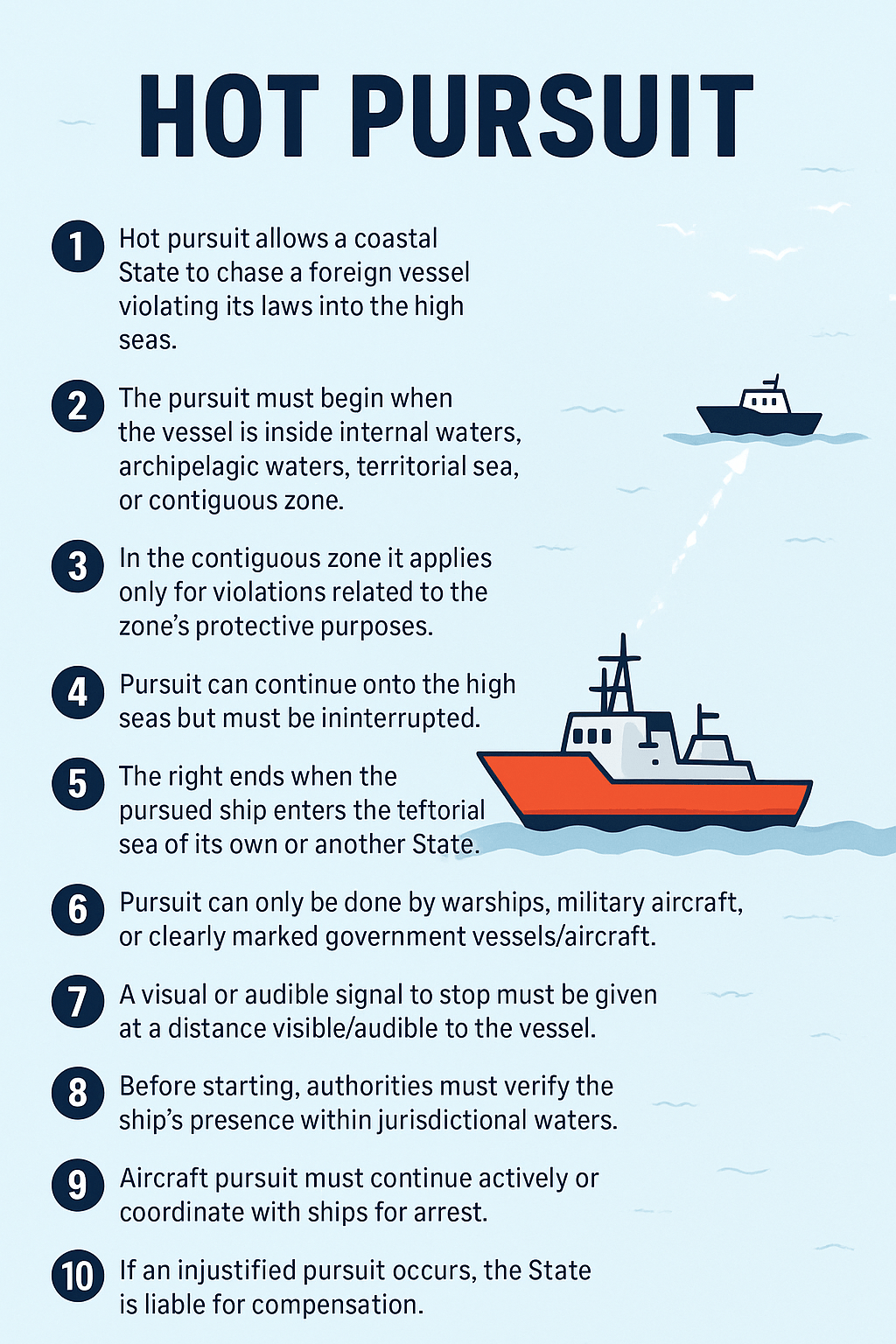
Hot pursuit refers to a coastal State’s right to pursue and arrest a foreign vessel that has violated its laws, even if the vessel flees into international waters. It’s a critical mechanism to prevent ships from escaping legal responsibility simply by crossing maritime boundaries.
⚓ When Does Hot Pursuit Apply?
The pursuit must begin when the foreign vessel is still within:
- Internal waters,
- Archipelagic waters,
- Territorial sea, or
- Contiguous zone (for protective violations only).
Importantly, the pursuit must start without delay and continue uninterrupted onto the high seas. If the vessel enters the territorial waters of another State, the pursuit must stop.
🚁 Who Can Pursue?
Only specific State authorities are authorized to conduct a hot pursuit:
- Warships,
- Military aircraft, or
- Government vessels/aircraft clearly marked as official.
These entities must issue a visual or audible order to stop, which the vessel can perceive.
🛡️ Legal and Practical Considerations
Before initiating pursuit, authorities must confirm that the vessel was within the jurisdictional waters when the violation occurred. In the case of aircraft, the pursuit must remain active or coordinate with ships to make an arrest.
If a coastal State conducts an unjustified hot pursuit or wrongfully arrests a vessel, it can be held liable for compensation.
🌍 Why It Matters
Hot pursuit plays a pivotal role in combatting:
- Drug smuggling,
- Illegal fishing,
- Human trafficking, and
- Other transnational maritime crimes.
It allows coastal States to protect their marine resources, uphold the rule of law at sea, and ensure that violators cannot simply escape by crossing invisible lines.
If you’re interested, I can draft a follow-up post with real-world cases of hot pursuit or best practices for maritime law enforcement. Let me know! 🌊✍️
🌊 핫 퍼슈트(HOT PURSUIT)란 무엇인가?
국제해양법에서 핫 퍼슈트는 연안국이 자국 법령을 위반한 외국 선박을 자국 영해 밖까지 추적할 수 있는 권리입니다. 이 권리는 UNCLOS(유엔해양법협약) 제111조에 명시되어 있으며, 다음과 같은 요건과 범위로 정의됩니다unclos_e.
🔎 1️⃣ 언제 핫 퍼슈트가 가능한가?
- 연안국 당국이 선박이 자국의 법률·규정을 위반했다고 합리적으로 믿을 때
- 추적은 반드시 그 선박이 내수, 군도수역, 영해, 접속수역 안에 있을 때 시작해야 함
- 접속수역(Contiguous Zone)에서는 해당 수역의 보호 목적과 관련된 위반일 때만 가능
🚢 2️⃣ 어디까지 추적할 수 있는가?
- 영해 또는 접속수역을 벗어나 공해까지도 계속 가능, 단 중단 없이 이어져야 함
- 자국 EEZ(배타적경제수역)나 대륙붕 안전구역에서의 위반에도 준용됨
- 추적은 타국 영해에 진입하면 즉시 종료됨
📢 3️⃣ 어떻게 시작해야 하는가?
- 시각적 또는 청각적으로 선박에 정지 명령 신호를 주어야 함 (외국 선박이 볼/들을 수 있어야 함)
- 추적 전, 해당 선박이 자국 수역 내에 있었다는 점을 합리적 수단으로 확인해야 함
🛡️ 4️⃣ 누가 추적할 수 있는가?
- 군함, 군용 항공기, 또는 정부 공무에 명확히 표시된 선박·항공기만 수행 가능
- 항공기에 의한 경우, 추적 명령 후 계속해서 추적하거나 다른 선박·항공기에 인계해야 함
⚠️ 5️⃣ 오남용 시 보상책임
- 정당하지 않은 상황에서 공해에서 정지·체포한 경우, 해당 선박에 손해배상 책임 발생
🌐 실무 중요성
핫 퍼슈트는 해양에서 마약 밀수, 불법 어획, 해적행위 등 초국경 범죄 대응의 핵심 수단입니다. 하지만:
- 적법 절차와 무력 사용의 최소화 원칙을 지켜야 하며,
- 타국 영해 존중 및 과잉집행 방지가 중요합니다.
따라서 각국 해양경찰·해군은 법률적 근거를 명확히 이해하고, 현장에서 체계적인 법집행 훈련을 받아야 합니다.
 You are now at Maritime Security Insights
Leave a comment