Published: April 2025 | MarePress
Overview
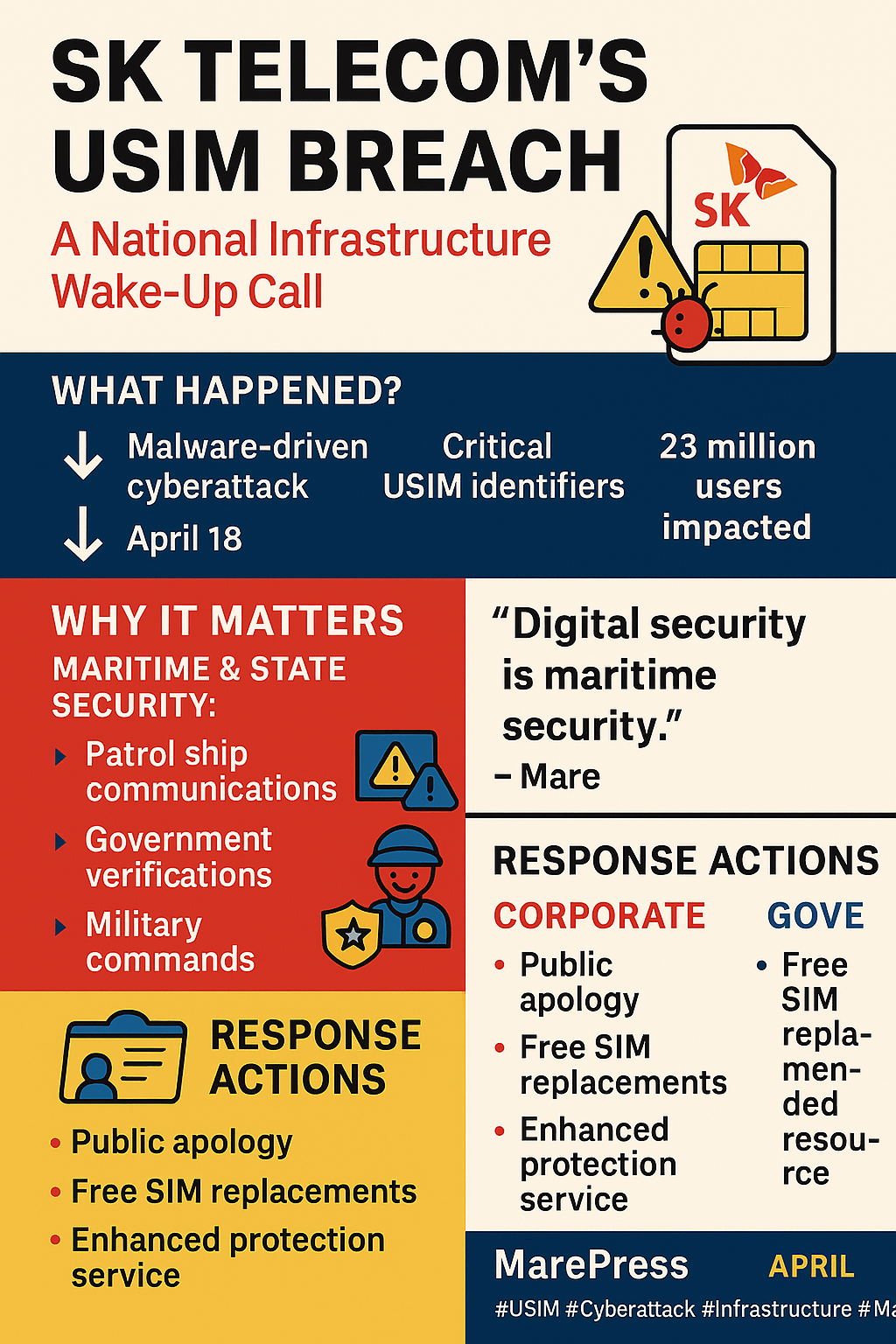
In April 2025, South Korea’s leading telecom operator, SK Telecom, was the victim of one of the most significant cyberattacks in the nation’s digital history. A malware-based breach of its USIM (Universal Subscriber Identity Module) infrastructure compromised the sensitive data of an estimated 23 million users, raising urgent questions about digital sovereignty, cyber readiness, and the security of national communication networks.
What Happened?
The breach was discovered on April 18, when SKT’s internal threat monitoring systems flagged anomalous behavior in core USIM systems. Subsequent forensic analysis revealed a coordinated cyberattack that exposed critical identifiers such as IMSI codes, authentication keys, and other subscriber-level credentials stored in SIM card infrastructure.
This was not just a standard data breach — it was an infiltration of a nation’s mobile identity fabric, making it one of the most serious infrastructure-level cyber incidents ever recorded in East Asia.
Why It Matters to National & Maritime Security
While the majority of public discussion has focused on consumer privacy, MarePress asserts this event holds strategic consequences for sectors beyond telecommunications:
- Maritime Patrol Communications: Many coast guard and maritime enforcement units in South Korea rely on commercial mobile SIM infrastructure as part of their secure routing and communication fallback systems.
- Government Identity Verification: USIM credentials are often cross-linked to public services, e-government apps, and emergency authorization systems.
- Military Command Redundancy: Although the defense sector maintains its own networks, USIM vulnerabilities could expose routing information or location metadata of key personnel.
The breach reveals how digital chips inside personal devices have become embedded nodes in the broader national security mesh.
Corporate & Government Response
SK Telecom’s response was swift and publicly accountable:
- Full disclosure within 48 hours
- Free USIM card replacement offered to all 23 million users
- Roll-out of the “USIM Protection Service” to prevent SIM cloning and fraud
- CEO press conference emphasizing “zero tolerance for cybersecurity failure”
The Korean Government responded with:
- A nationwide telecom infrastructure audit initiated by the Ministry of Science and ICT
- Active involvement of KISA (Korea Internet & Security Agency) to explore new encryption standards
- Legislative motion proposed to amend the Telecommunications Business Act to enforce stricter USIM lifecycle tracking
Mare’s View
“This wasn’t just a hack. It was a red-flag signal for what cyberwarfare looks like in infrastructure terms. When attackers can access millions of mobile identities, the consequences echo far beyond personal data. They reach the core of sovereignty.”
— Mare
What Comes Next?
- Increased scrutiny of third-party SIM suppliers
- Potential redesign of national USIM architecture for both civilian and strategic use
- Simulation-based cyberdrills across telecom, energy, and transport sectors
- International cyber-cooperation with NATO and ASEAN digital security units
SK Telecom’s breach serves as a case study for telecoms globally: infrastructure is the new frontline, and digital trust is the new currency of sovereignty.
 You are now at Maritime Security Insights
Leave a comment