By Mare | April 28, 2025
China and the Philippines Clash Over Sandy Cay Amid South China Sea Tensions
Published: April 28, 2025 | Source: The Washington Post
Summary
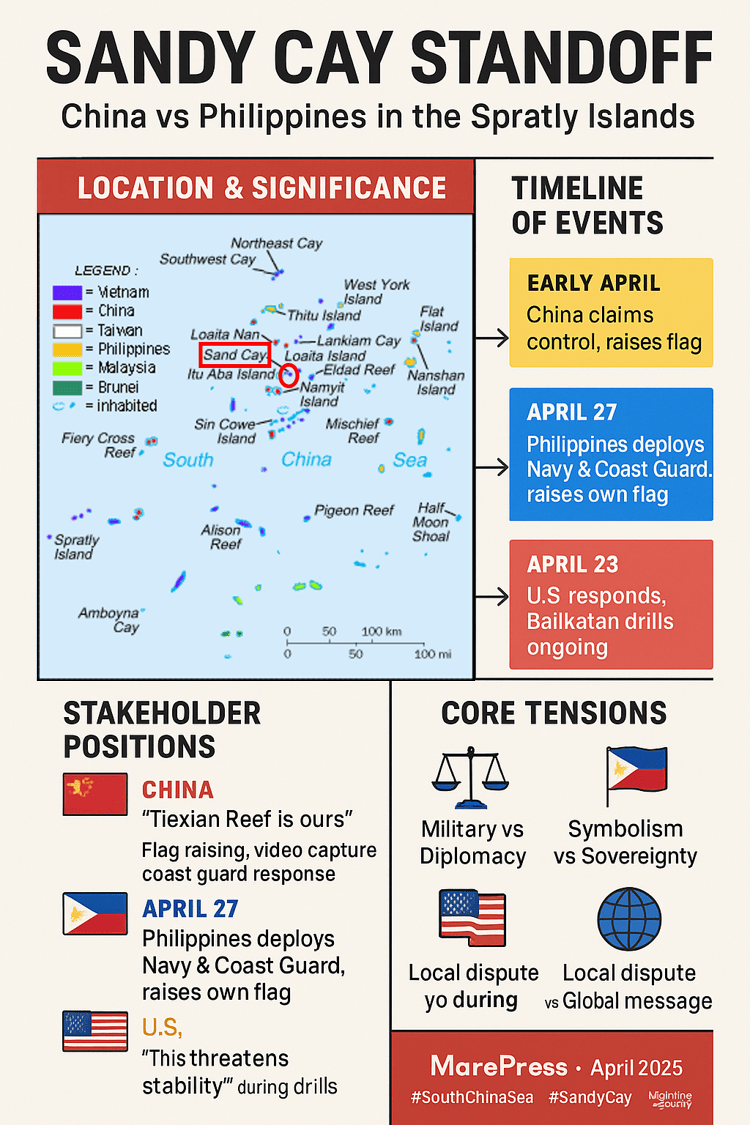
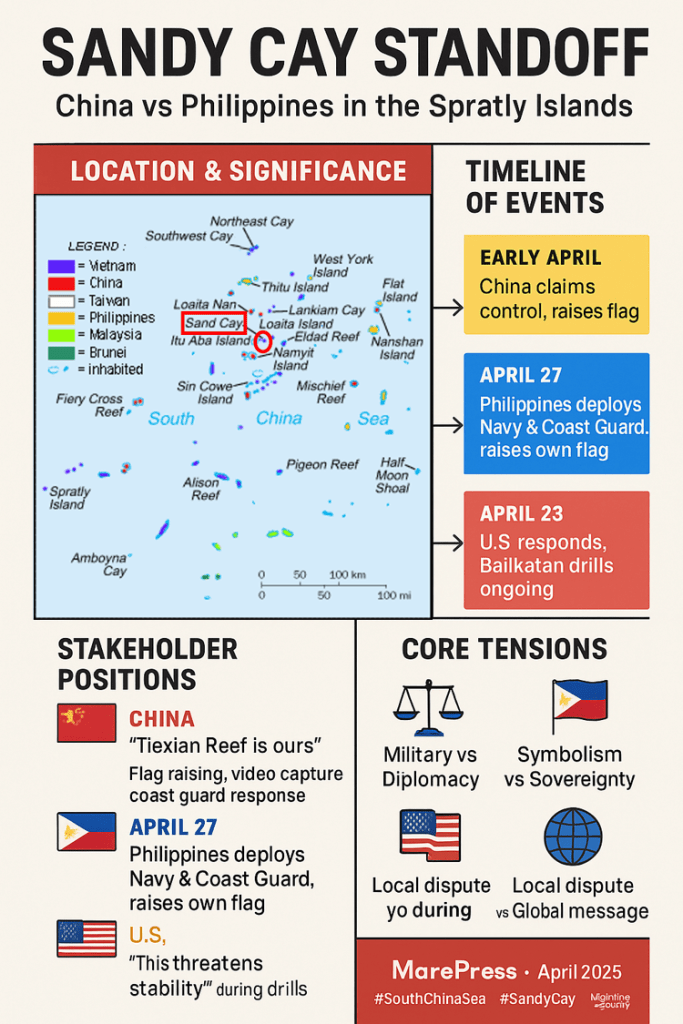
The long-standing maritime dispute between China and the Philippines has flared once again over Sandy Cay, a small but strategically located reef in the South China Sea. Both countries have raised their national flags on the contested feature, renewing tensions at a time when the Philippines is conducting joint military drills with the United States.
What happened at Sandy Cay this week is not merely a symbolic standoff—it’s a window into the new geography of deterrence in the Indo-Pacific. A sandbar in the middle of the sea has once again revealed the limits of diplomacy and the primacy of maritime presence.
For the Philippines, planting a flag is a constitutional assertion. For China, a flag is a strategic signal. For the U.S., it is a red line test.
The significance of Sandy Cay lies not in its size but in its visibility. It is the perfect proxy terrain—small enough to avoid war, but big enough to make a point. Each act—be it a landing, a flag, a drill—is a narrative move in the theater of maritime legitimacy.
If this reef war continues, what will matter most is not whose flag flew first, but who stays longer, and with what kind of legitimacy. In maritime strategy, persistence is power.
Key Developments
1. Competing Sovereignty Displays
- The Chinese Coast Guard unfurled a national flag on Sandy Cay (which China calls Tiexian Reef) and declared enforcement of maritime control.
- In response, the Philippine Navy and Coast Guard deployed forces to the same reef and neighboring islands, raising the Filipino flag and asserting national jurisdiction.
2. Timed with U.S.-Philippines Military Drills
- The event coincides with the ongoing Balikatan 2025 exercises, a major U.S.-Philippines joint operation involving over 14,000 troops.
- The U.S. expressed deep concern over the reports, warning that such actions undermine regional stability and violate international law.
3. ASEAN Talks and Diplomatic Undermining
- Chinese officials had recently held talks with ASEAN representatives in Manila to reduce tensions in the South China Sea.
- Analysts argue that this military show of force directly contradicts China’s diplomatic messaging, weakening efforts to negotiate a code of conduct in disputed waters.
4. Provocation or Demonstration?
- No permanent Chinese occupation of the reef has been verified.
- Experts describe the move as “highly provocative,” though possibly intended as a short-term demonstration rather than long-term control.
Background: Why Sandy Cay Matters
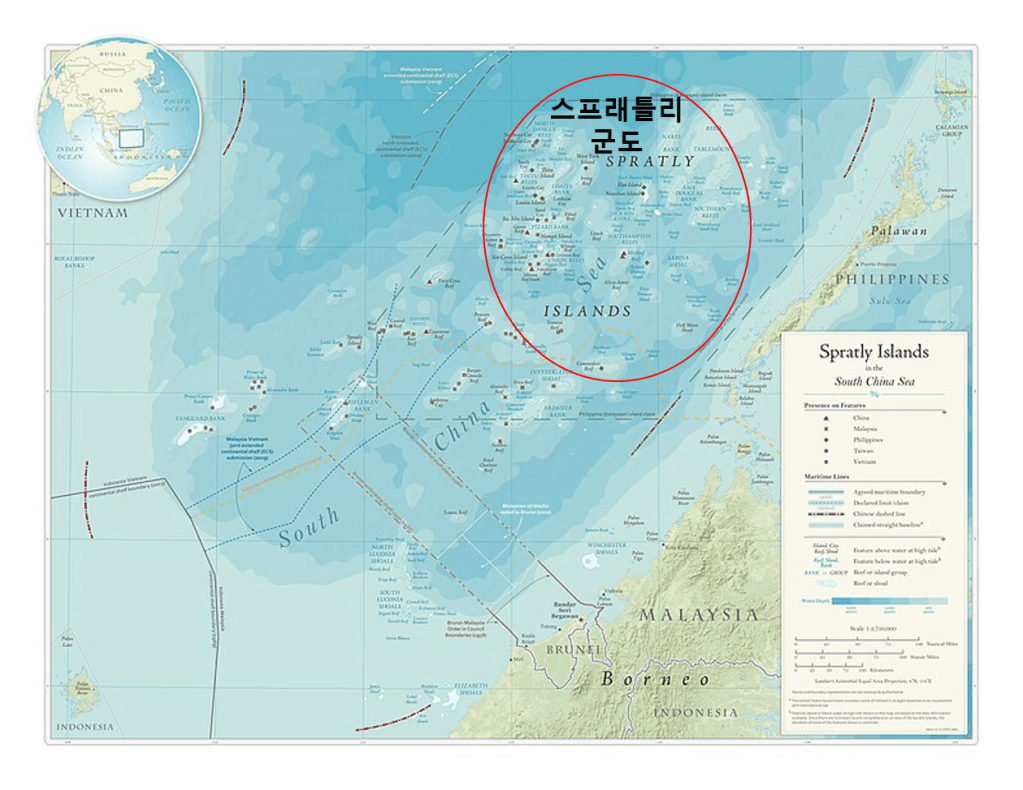
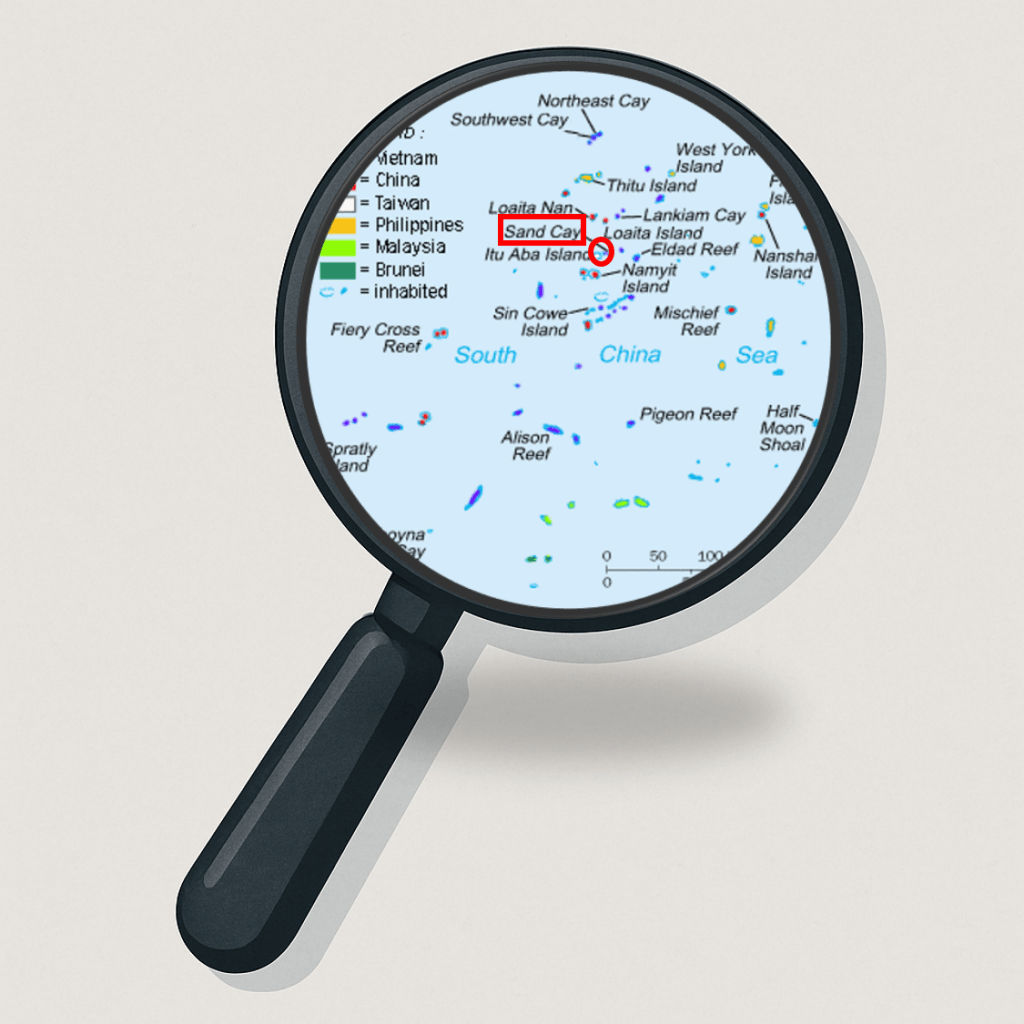
- Sandy Cay is located between Philippine-held Thitu Island and China’s militarized Subi Reef—both part of the Spratly Islands, claimed by multiple parties.
- It has previously been the scene of naval encounters, blockades, and aborted infrastructure projects, notably in 2017 when Manila dropped plans for a fisherman shelter after Beijing objected.
Philippine Government’s Position
- The National Task Force for the West Philippine Sea stated that the operation demonstrates the country’s “unwavering commitment to sovereignty and maritime rights.”
- A senior Philippine security official called on China to exercise restraint and avoid escalating tension.
Beijing’s Response
- Chinese officials claimed six Filipinos attempted an “illegal landing” and that China had acted “in accordance with the law.”
- Chinese media and think tanks blamed both the Philippines and the U.S., describing the Philippines as “habitual opportunists emboldened by American support.“
 You are now at Maritime Security Insights
Leave a comment