Discover how Official Development Assistance (ODA) programs led by Coast Guards are strengthening maritime security around the world. Learn about strategic goals, priority regions, and future prospects.

Introduction to Maritime Security and ODA
Maritime security is essential for safeguarding global trade, protecting marine resources, and ensuring the safety of coastal communities.
Today, Coast Guard agencies play an increasingly important role in supporting maritime security, not only through their domestic operations but also via international cooperation. One of the most effective tools for fostering such cooperation is Official Development Assistance (ODA).
By leveraging ODA programs, Coast Guards help developing countries build maritime law enforcement capacities, strengthen port security, and combat transnational crimes such as illegal fishing(IUU), smuggling, and maritime piracy.
The Role of the Coast Guard in Maritime ODA Programs
Why Coast Guards Lead ODA Projects
Coast Guard organizations have unique expertise in maritime law enforcement, search and rescue, environmental protection, and humanitarian missions.
This positions them perfectly to lead development projects aimed at improving maritime governance in vulnerable regions.
ODA initiatives led by Coast Guards often focus on:
- Building and donating patrol vessels
- Training local maritime enforcement officers
- Establishing joint information-sharing platforms
- Supporting legal framework development related to maritime security
Such efforts help partner countries enhance their self-reliance in managing maritime risks and contribute to regional stability.
Priority Regions for Maritime ODA Cooperation
Recognizing the strategic importance of certain maritime zones, many Coast Guards prioritize ODA support for specific regions:
- Southeast Asia: Addressing illegal, unreported, and unregulated (IUU) fishing and territorial security issues
- Pacific Island States: Strengthening capacity to manage vast exclusive economic zones (EEZs)
- Africa’s Coastal Regions: Combating piracy and enhancing port security
- Latin America and the Caribbean: Cooperation against maritime drug trafficking
The South China Sea, Gulf of Guinea, and Caribbean Sea are examples of areas where enhanced maritime governance has a direct impact on global security.
Success Cases: Strengthening Maritime Law Enforcement
Several ODA projects led by Coast Guard authorities have already shown measurable success:
- Provision of high-speed patrol boats to Pacific Island nations to enable better EEZ monitoring
- Specialized training on oil spill response and environmental protection in Southeast Asia
- Joint operations and exchange programs with African maritime security forces
These activities not only protect marine environments and economic interests but also foster stronger diplomatic relations.
Future Prospects and Strategic Vision
Looking ahead, Coast Guard ODA programs are expected to evolve into even more comprehensive partnerships.
Key trends include:
- Integrated ODA Approaches: Combining maritime law enforcement support with sustainable fisheries management and disaster response planning
- Focus on Digitalization: Helping partner countries develop maritime domain awareness systems using satellite and AI technologies
- Regional Cooperation Frameworks: Building multilateral maritime security networks beyond bilateral assistance
Ultimately, Coast Guard-led ODA efforts will continue to contribute significantly to a safer, more secure, and more sustainable maritime environment.
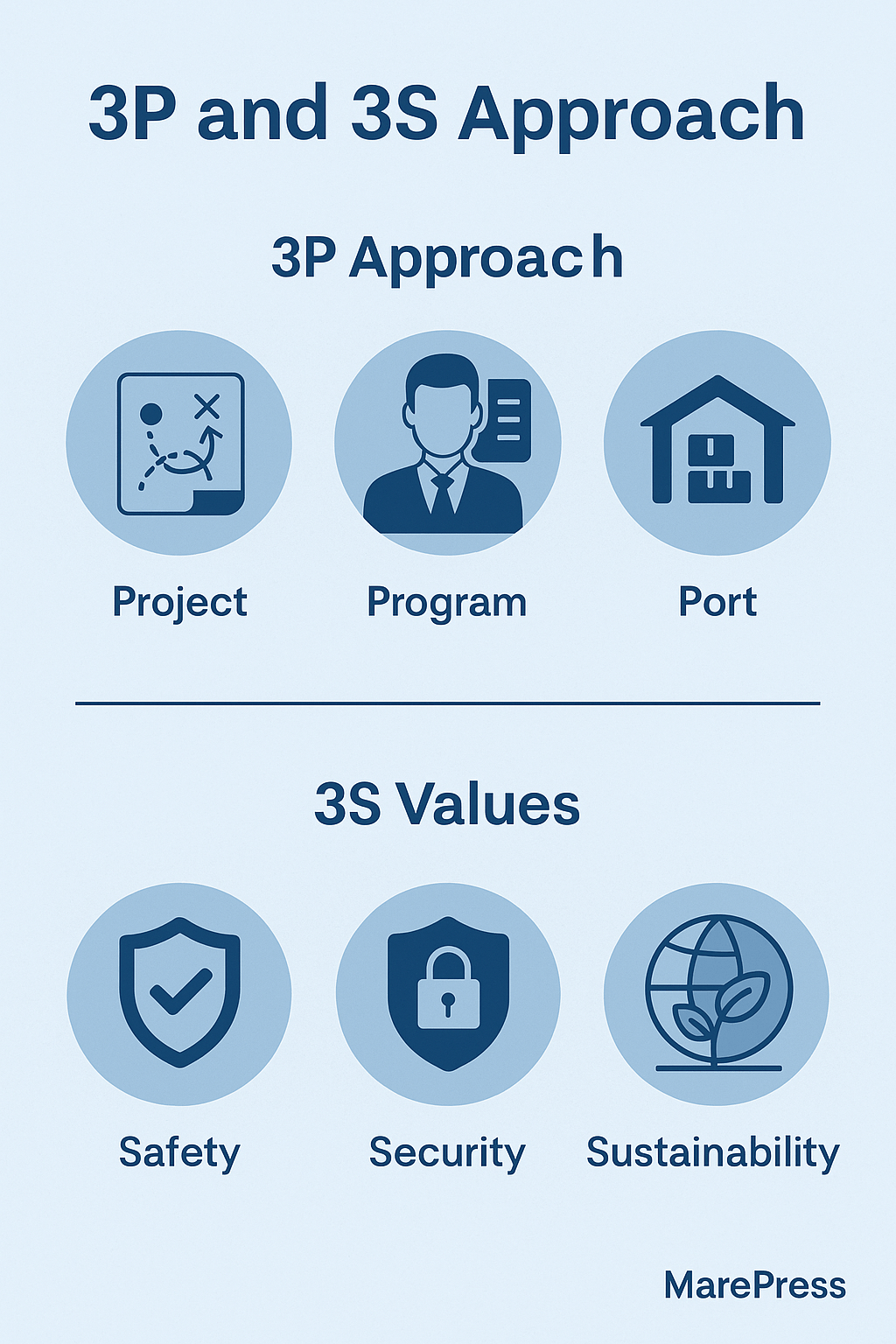
3P and 3S Approach for Maritime Security ODA
3P Approach: Project, Program, Port
In advancing maritime security through Coast Guard ODA initiatives, MarePress emphasizes a strategic 3P Approach:
- Project: Deliver essential maritime security infrastructure through tailored projects, such as patrol vessel provision, surveillance system upgrades, and coastal monitoring installations.
- Program: Conduct comprehensive education, training, and capacity-building programs to enhance the operational capabilities of partner nations’ maritime forces.
- Port: Establish, modernize, and maintain key port facilities and logistics hubs critical for maritime law enforcement, including MRO (Maintenance, Repair, and Overhaul) centers and localized training facilities.
By focusing simultaneously on infrastructure, human resource development, and operational bases, the 3P strategy ensures a sustainable foundation for maritime security in developing regions.
3S Values: Safety, Security, Sustainability
In parallel with the 3P approach, the 3S Values guide every aspect of Coast Guard ODA efforts:
- Safety: Ensure safe navigation, shipping, and maritime activities for all users of the sea.
- Security: Strengthen maritime law enforcement capabilities to combat piracy, smuggling, illegal fishing, and transnational maritime crimes.
- Sustainability: Promote the long-term conservation of marine environments and the sustainable use of ocean resources to benefit future generations.
By upholding these 3S values, ODA projects contribute not just to short-term security goals, but to the creation of resilient, self-sustaining maritime societies.
MarePress Closing Thoughts
Maritime security is not just a national issue; it is a shared global responsibility.
Through targeted ODA initiatives, Coast Guards worldwide are helping to bridge capability gaps, strengthen rule of law at sea, and create a safer future for all.
MarePress supports efforts to expand maritime ODA and strengthen international maritime security cooperation for a better world.
 You are now at Maritime Security Insights
Leave a comment