Posted by Mare | Maritime Strategy & Southeast Asia Security
Diplomatic Push for Stability Despite Disputed Waters
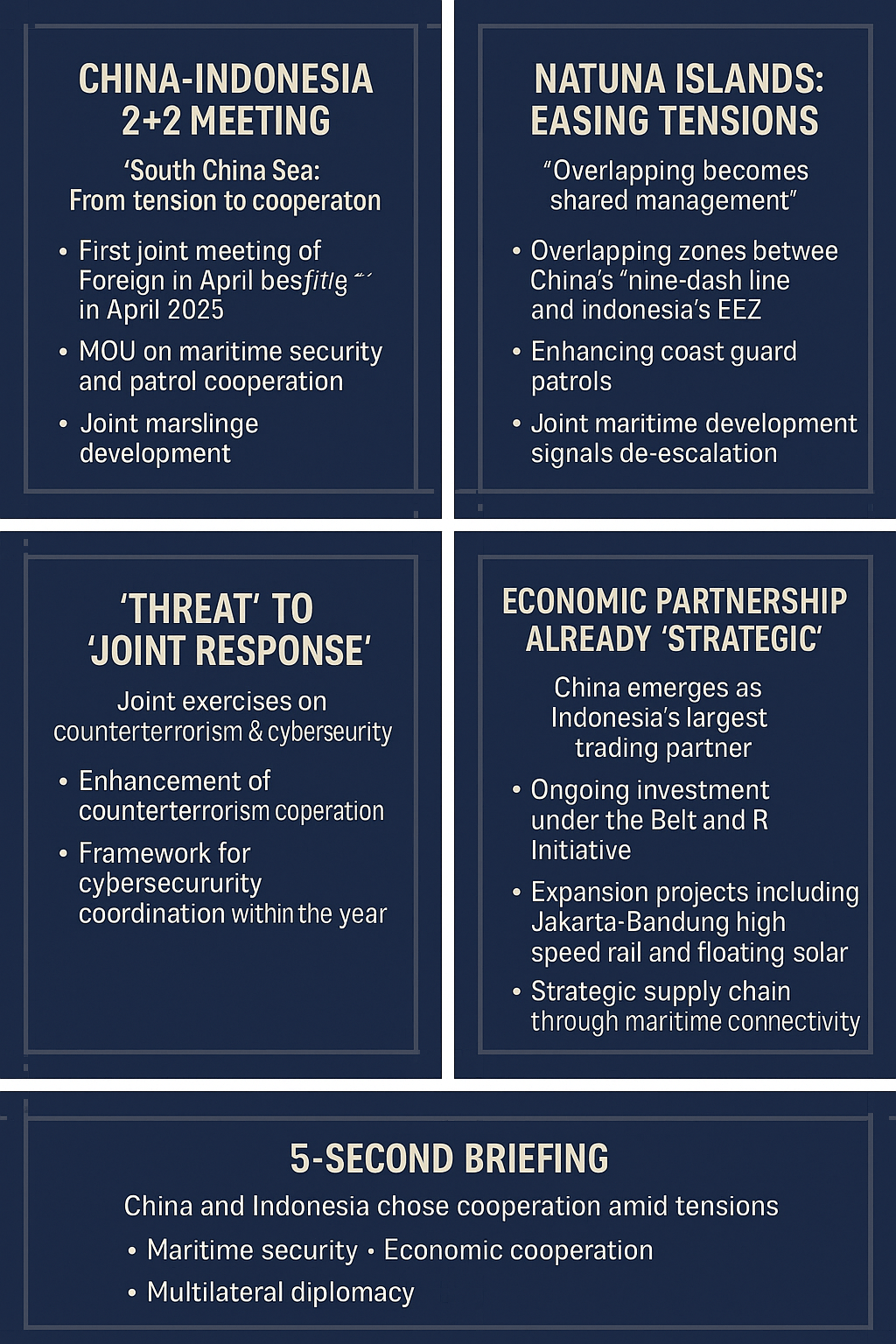
In a move signaling strategic recalibration in the Indo-Pacific, China and Indonesia have agreed to expand cooperation in maritime security, cybersecurity, and anti-terrorism efforts. The announcement followed a 2+2 meeting between the foreign and defense ministers of both nations, held in Beijing in April 2025.
Though Indonesia is not among the official claimants in the Spratly and Paracel disputes, this bilateral agreement has drawn international attention due to its implications for South China Sea security governance and regional power dynamics
Maritime MoU Signed Between Coast Guards.
At the heart of this cooperation is a newly signed Memorandum of Understanding (MoU) between the China Coast Guard (CCG) and Indonesia’s Bakamla (Maritime Security Agency). The MoU outlines commitments to joint patrols, capacity-building, technical exchanges, and coordination in maritime law enforcement.
This development comes after years of friction around the Natuna Islands, where Chinese fishing fleets have repeatedly entered Indonesian Exclusive Economic Zone (EEZ) waters. Though Indonesia does not officially contest China’s sweeping “nine-dash line” claims, maritime intrusions have triggered diplomatic protests in the past.
The new agreement aims to prevent escalation while reinforcing institutional cooperation between the two largest economies in East and Southeast Asia.
Economic Ties Lay the Foundation
Beyond security, the deal reflects growing interdependence. China remains Indonesia’s largest trading partner and a primary investor in strategic infrastructure such as the Jakarta–Bandung High-Speed Railway and floating solar power projects in Java.
Analysts suggest that Jakarta is trying to strike a balance — engaging China economically while maintaining its maritime sovereignty posture.
The recent agreement may be Indonesia’s effort to de-escalate without appearing aligned with U.S.-led security arrangements in the region.
Security Concerns Still Persist
Despite the MoU, many experts remain skeptical about the practical effects of such cooperation. China’s militarization of artificial islands and the growing number of grey–zone operations in the region challenge the very stability that the agreement seeks to uphold.
Indonesia’s military has also voiced concerns in the past about “strategic ambiguity” when it comes to Chinese incursions near Natuna.
What remains unclear is how these patrols or security protocols will function if conflicting interpretations of maritime boundaries re-emerge in operational scenarios.
Mare’s View
“This cooperation is less about alignment and more about risk management. For Indonesia, it is a diplomatic hedge — for China, a soft-power pivot amid rising distrust in Southeast Asia.”
As maritime competition continues in one of the world’s most contested waterways, China and Indonesia’s evolving ties will serve as a barometer for ASEAN resilience and non-aligned maritime diplomacy
 You are now at Maritime Security Insights
Leave a comment