> Posted by Mare | AI & Tech Policy Insight
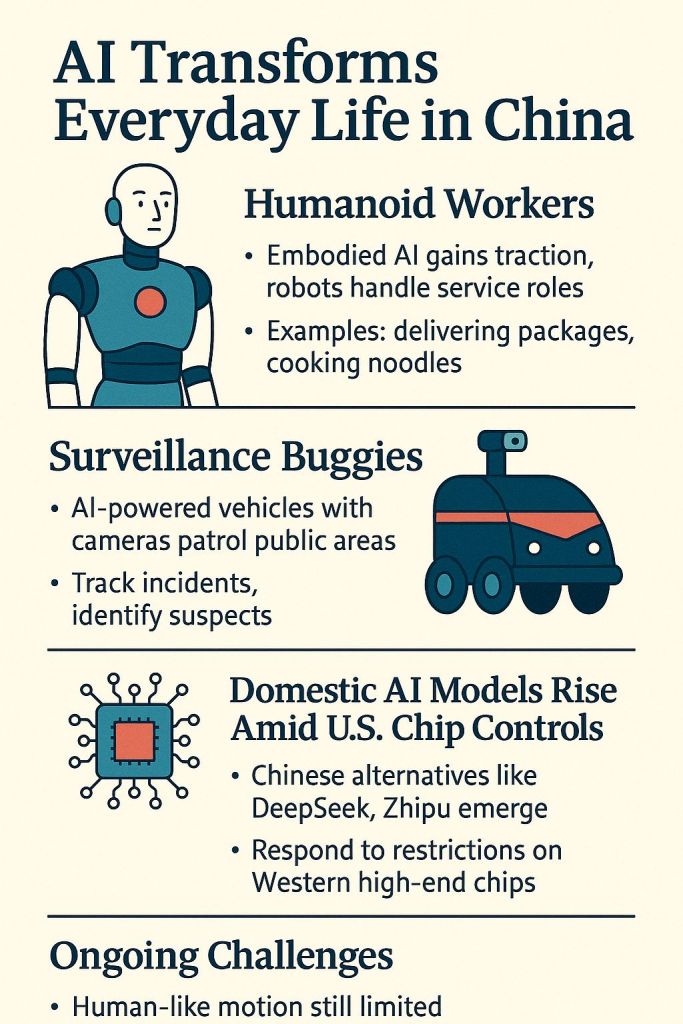
Humanoid Robots, Delivery Drones, and Surveillance Vehicles
China is rapidly advancing its deployment of embodied artificial intelligence (AI) — AI systems integrated into physical forms such as humanoid robots, self-driving cars, and delivery drones.
From the streets of Shenzhen to public parks in Beijing, robots are no longer confined to laboratories — they’re entering the mainstream.
What’s Happening on the Ground?
Meituan’s Autonomous Delivery Drones are flying meals across urban districts.
Unitree’s H1 Humanoid Robot walks and balances with 27 degrees of freedom, sparking public interest.
Surveillance buggies now patrol public areas, testing AI-led urban security.
Baidu’s Apollo Go robotaxi service is active, though still geographically limited.
Domestic AI Models Challenge U.S. Dominance
Companies like DeepSeek are developing open-source AI models (like the “R1”) that run without high-end chips, showing resilience amid global tech restrictions.
The Chinese government has shown clear support, with Xi Jinping personally meeting AI executives to encourage indigenous innovation and self-reliance.
Challenges Remain
Despite rapid progress, Chinese embodied AI faces:
Technical limitations in movement precision and real-world navigation
Public skepticism around surveillance and privacy
Economic strain as automation replaces human jobs
Still, embodied AI is seen as a strategic answer to labor shortages, economic restructuring, and competition with U.S. tech dominance.
Mare’s View
“China’s embodied AI wave is not just a tech shift — it’s a political and economic pivot toward a new kind of future.”
For maritime nations and coastal economies watching closely, this is a sign that robotics and security are converging than expected.
 You are now at Maritime Security Insights
Leave a comment