Published: April 15, 2025 | Source: Reuters
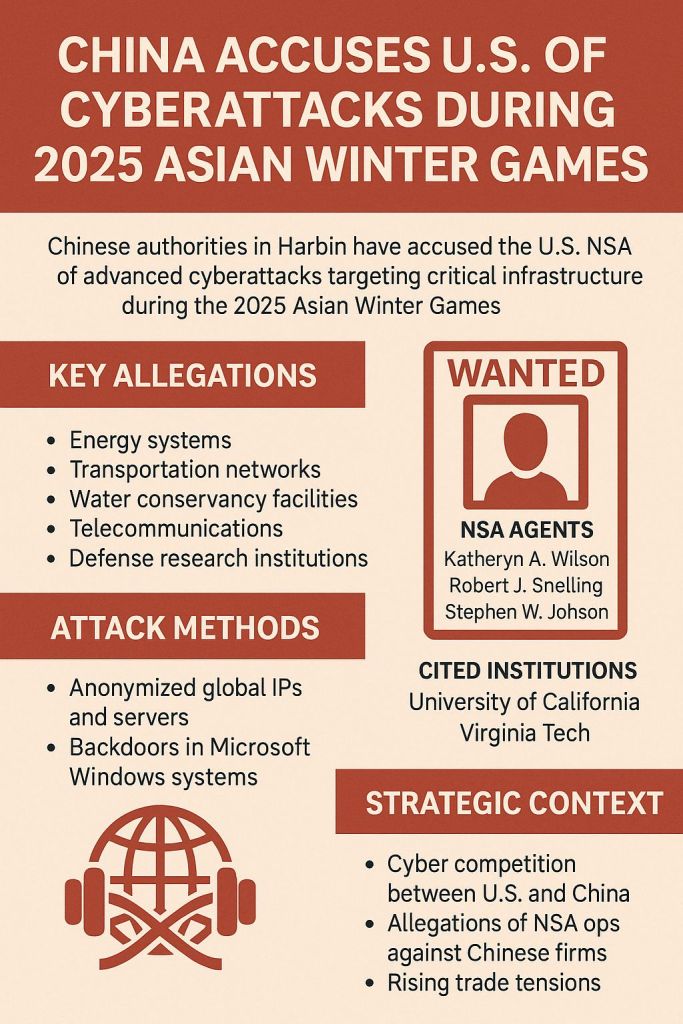
Overview
Chinese authorities in Harbin have publicly accused the U.S. National Security Agency (NSA) of launching advanced cyberattacks against critical infrastructure during the 2025 Asian Winter Games, escalating tensions between the two global powers in the digital domain
Key Allegations
1. Targeted Sectors
Energy systems
Transportation networks
Water conservancy facilities
Telecommunications
Defense research institutions
2. Methods of Attack
Use of anonymized global IPs and servers
Exploitation of backdoors in Microsoft Windows systems
Intrusions focused on athlete registration platforms and sensitive personal data
Named Suspects and Institutions
Chinese police placed three alleged NSA agents on a wanted list:
Katheryn A. Wilson
Robert J. Snelling
Stephen W. Johnson
U.S. academic institutions cited:
University of California
Virginia Tech
(Note: No specific technical evidence was made public)
Chinese police placed three alleged NSA agents on a wanted list:
Katheryn A. Wilson
Robert J. Snelling
Stephen W. Johnson
U.S. academic institutions cited:
University of California
Virginia Tech
(Note: No specific technical evidence was made public)
Strategic Context
This incident is part of a broader narrative of cyber competition between the U.S. and China, including:
Previous U.S. accusations of Chinese attacks on U.S. corporations and agencies
China’s counterclaims of NSA cyber-intrusions, including into companies like Huawei
Rising trade tensions and the weaponization of digital infrastructure
Why It Matters for Maritime & National Security
Signals a shift in cyberwarfare being deployed during international events
Demonstrates the vulnerability of event-specific infrastructure (e.g., registration systems, logistics platforms)
Raises questions on dual-use technologies and the role of universities in cyber operations
Read More
Original Reuters article:
 You are now at Maritime Security Insights
Leave a comment